


Prijava
Še niste registrirani? Vpišite seZa prijavo na dogodek se morate naprej registrirat na naši spletni strani.
29th Biennial of Design Ljubljana (BIO 29)
The 29th Biennial of Design, BIO 29, titled Soft Fields, explores how design can open up, redirect and redistribute knowledge within research, industrial and infrastructural environments. It approaches industry as an interconnected system of power, capital and nature, shaped by different forms of labour, knowledge and resource use.
The biennial understands design as a means of research, connection and negotiation between different interests and systems. Rather than seeking predetermined solutions, it creates space for alternative forms of collaboration, the exchange of knowledge and the testing of new possibilities. Particular attention is given to the relationships between people, technology and the environment, and to how design practices can contribute to understanding and transforming existing systems.
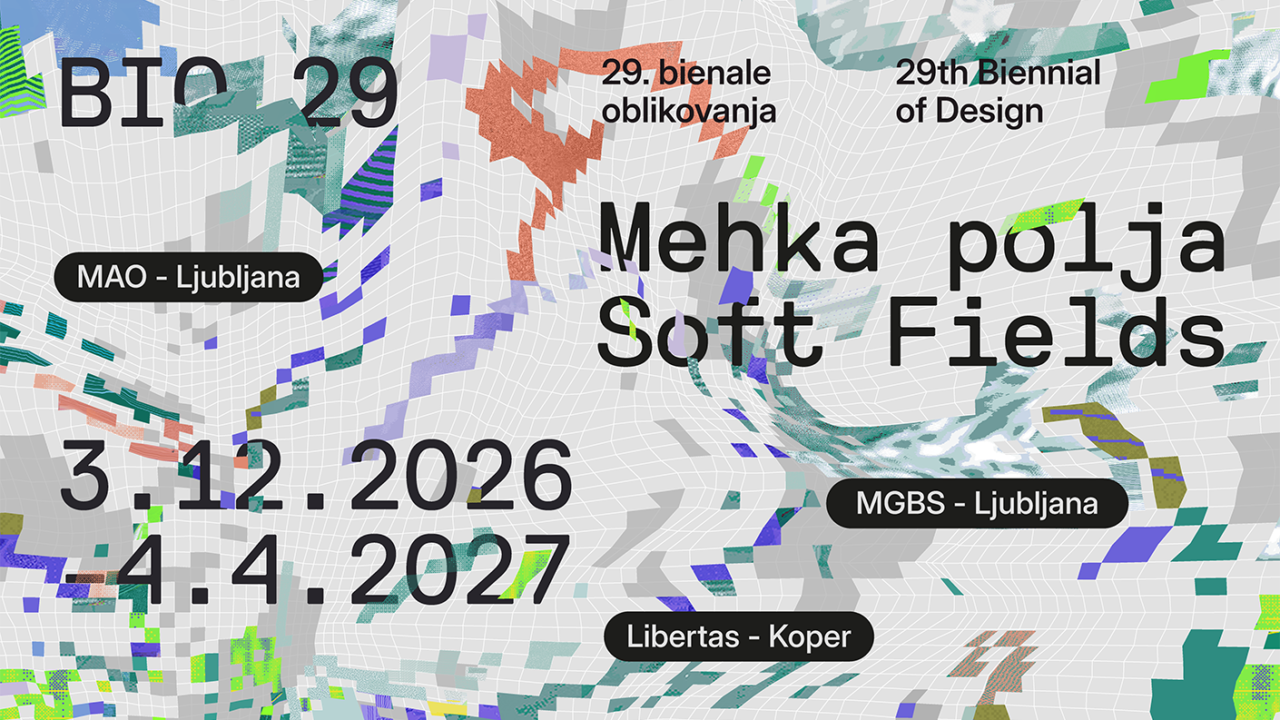
BIO 29 takes place from 3 December 2026 to 4 April 2027 in Ljubljana and Koper, Slovenia. It is organised by the Museum of Architecture and Design (MAO) in cooperation with the Centre for Creativity (CzK).
The Production Platform: From Research to New Connections
An important part of BIO 29 is the Production Platform, supported by the Centre for Creativity. It supports the development and production of new design-led research projects, connecting Slovenian and international designers with researchers, experts, public institutions, companies, industry partners and local communities across Slovenia.
Within BIO 29, the Production Platform primarily takes shape through the Experimental Practices programme, which brings together new projects rooted in the exploration of specific Slovenian contexts, their particularities, challenges and potential. Designers work alongside the people and organisations who know these environments and are actively involved in them. The processes involve field visits, conversations, gathering and exchanging knowledge, workshops, material experimentation, prototyping and testing ideas in practice.
The platform encourages encounters between disciplines and fields that do not often intersect. Design enters into dialogue with science, technology, industry, cultural heritage and the experiences of local communities. The outcome is not necessarily a set of finished solutions, but new ways of understanding challenges, working together and thinking about the future.
The Production Platform has been an important part of the biennial’s history since BIO 50 in 2014, when, under the direction of Jan Boelen, collaboration was placed at the centre of its approach. BIO 29 continues this tradition through research and production processes that connect design with concrete social, environmental and technological questions.
Projects Rooted in Specific Contexts
The projects developed through the BIO 29 Production Platform emerge from diverse Slovenian contexts and address questions of shared resources, environmental stewardship, industrial heritage, infrastructure and technological development.
These include:
- Res communes – Urška Kristina Škerl and Krisentab (Giacomo Nanni and Fidel Thomet) investigate the concept of the public good in the municipalities of Koper and Ankaran, examining who has actual access to shared land and public space.
- Erratic Flows – Swamp_Matter and Lučka Centa explore different forms of knowledge about water in the Klariči karst aquifer, bringing scientific, folk and embodied ways of understanding the landscape into dialogue.
- Forestry Protocols – Katjuša Rupnik, Tinkara Rakovec and Leo Larche Hitchcox develop a new approach to observing and documenting forests, bringing together foresters, other forest users and their different forms of knowledge.
- Mehanka – Tatjana Kotnik, Gaja Pegan Nahtigal and Liza Sočan explore the heritage of the former women’s factory Mehanika in Trbovlje. Through foraging, pottery and cooking, they develop a mobile kitchen and pantry using locally sourced and reclaimed materials.
- Petola: Living Heritage in the Salt Pans – Gaia D’Arrigo and Rebecca Schedler explore the Sečovlje Salt Pans as a living ecological system and investigate possibilities for preserving and regenerating petola, the living layer essential to traditional salt production.
Other projects engage with contemporary technologies, digital environments and new material practices. These include an exploration of the digital representation of military infrastructure in Soft Fields Within Reinforced Walls (Emma Canton, Sofia Tapia Bucheli and Frida Law); the experimental video game Still Water (Dorijan Šiško and Jaka Juhant), which explores the connections between water, energy and data infrastructure; Acid Patina (Dan Adlešič), investigating chemical processes and new properties of wood; and Climate Control (Soft Baroque), which reinterprets ventilation systems as sculptural objects.
New Collaborations Across Design, Science and Industry
One of the Production Platform’s key strengths lies in its broad network of participating organisations and experts. The projects bring together Slovenian museums, research institutes, universities, companies, public institutions and local organisations. These include the Technical Museum of Slovenia, Zasavje Museum Trbovlje, the Slovenian Mycology Museum, the Institute of Contemporary History, the Anton Melik Geographical Institute at the Research Centre of the Slovenian Academy of Sciences and Arts (ZRC SAZU), the Karst Research Institute, the Forestry Institute of Slovenia, InnoRenew CoE, the University of Ljubljana, Kraški vodovod and Soline – Pridelava soli, among others.
These collaborations give designers access to specialised knowledge, research data, materials, infrastructure and the experience of people working in specific fields and environments. At the same time, they offer participating institutions and companies new perspectives and opportunities to approach their work and challenges through alternative creative and research methods.
In this way, the Production Platform strengthens connections between Slovenia’s creative sector and its scientific, cultural and economic environments, while opening up possibilities for longer-term collaboration between designers and other disciplines. It demonstrates that design is not limited to the production of a final object: it can also serve as a research tool, a means of connecting different fields and a catalyst for developing new ideas.